
Mighty Ride Moto · Independent Can-Am Spyder Specialists
What Does BRAKE FAILURE Mean on a Can-Am Spyder?
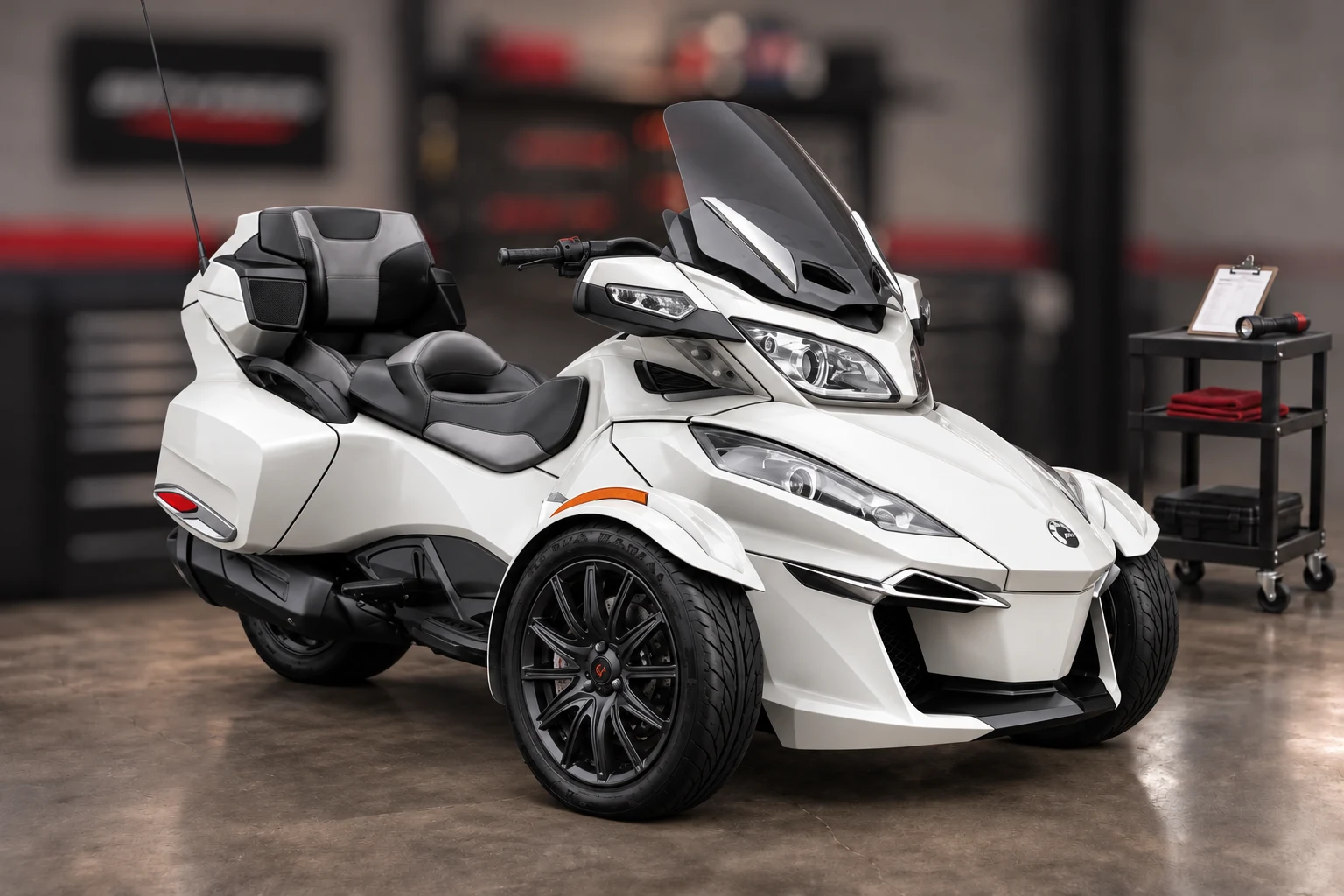
A BRAKE FAILURE message deserves your attention even when your Spyder still seems to stop normally. It can indicate something as straightforward as a low brake-fluid level, but it can also point to a problem that affects braking. Treat the brakes as potentially compromised until you know why the warning appeared.
If it happens while riding, slow down and stop somewhere safe. Do not continue your trip simply because the pedal feels familiar.
The message is a warning, not a complete diagnosis
The words on the dashboard do not identify one failed part. Depending on the model and year, the warning may relate to fluid level, a fluid-level sensor, a pressure problem, or a brake-switch fault. Some displays provide more detail, such as LOW BRAKE FLUID.
A specific diagnostic code helps narrow the investigation. It still needs to be considered alongside pedal feel, visible condition and what happened before the message appeared. A parking-brake warning and a service-brake warning also need to be distinguished; they should not be treated as interchangeable.
When safely parked, photograph the exact message and record the year, model and any accompanying codes. Note whether it appeared at startup, while braking, or after recent brake work. Those details help a technician investigate the right problem.
Sometimes the fix is as simple as correcting the fluid level
If a genuinely low fluid level triggered the warning, restoring the proper level may make the message disappear without replacing a part. The amount matters: adding a token splash without checking the resulting level may not correct the problem.
Use fresh DOT 4 brake fluid from a sealed container. You do not need a particular brand; you do need the specified fluid and a clean container. Do not substitute silicone DOT 5.
Check and fill with the Spyder parked on firm, level ground. A slope can make the level misleading. Identify the brake reservoir using the instructions for your exact model and year. On many older Spyders, both brake-fluid reservoirs are beneath the seat. Do not confuse the clutch reservoir on a manual model with the brake reservoirs.
Clean the cap and surrounding area before opening it, protect painted and plastic surfaces, and check both brake reservoirs or chambers where fitted. Add fluid carefully to the specified MAX level, then refit the cap and diaphragm correctly. Follow the model-specific instructions rather than estimating a universal amount.
Low fluid needs an explanation. It can accompany pad wear or a leak. Repeatedly topping up a reservoir that keeps dropping is not a repair. An empty reservoir, visible leakage or an abnormal pedal requires service before riding. Topping up also does not replace an overdue fluid change or bleeding when air is present.
Does BRAKE FAILURE always require BUDS to correct it?
No. A fluid-level warning does not automatically mean diagnostic software is needed to make it go away. Correcting the underlying low-level condition may resolve that warning.
Other faults can require diagnostic work, a model-specific reset or brake-system service. Correcting the problem, clearing a stored fault and validating the repair are separate steps. A reset cannot repair a leak, remove air, restore worn components or fix a faulty switch.
Avoid applying a reset sequence from another Spyder without checking the exact year and fault. If the message remains or returns at the correct fluid level, have the cause investigated instead of repeatedly resetting it or adding more fluid.
How can you check your brakes safely?
Start with stationary checks. Do not use a road test to discover whether a Spyder with an unresolved brake warning can stop.
With the machine secured on level ground, look for fluid leaks and check the reservoirs. Apply firm, steady pressure to the brake pedal. It should provide consistent resistance without excessive travel, a spongy feel or continued sinking. Repeated pumping should not be necessary to obtain a usable pedal. Check for a warning during and after the application.
If any of these checks is abnormal, leave the Spyder parked and arrange service. Accessible pads and discs also need inspection for wear or damage; looking at one visible pad does not assess the whole system.
Once the cause has been addressed, no warning remains and the stationary checks pass, a cautious walking-speed check can confirm basic stopping operation:
- Choose a dry, level, empty paved area with ample unobstructed space. Wear your normal riding gear and leave passengers and trailers out of the test.
- Move straight ahead at walking pace. Release the throttle fully; on a manual model, pull in the clutch as you stop.
- Apply the brake smoothly. The Spyder should stop promptly and predictably without pulling, unusual pedal travel or a returning warning.
- Repeat only if the first stop is normal. Stop testing immediately if anything changes.
Do not escalate this into a high-speed stop or an attempt to trigger ABS to prove the brakes are safe.
What establishes that the problem has been resolved?
A satisfactory low-speed check confirms basic braking under those conditions. It does not measure each wheel's braking contribution or prove emergency-stop performance and ABS operation.
For a brake fault, confidence comes from identifying and correcting the cause, inspecting the relevant components, and passing the applicable model-specific checks. A pressure-related fault may require measured hydraulic-pressure validation and checking switch operation. Air in the system requires the proper bleeding procedure and subsequent verification. The necessary checks depend on the fault.
A warning that disappears is useful information. Combine it with correct fluid level, no leakage, normal pedal operation and appropriate verification of the underlying problem. If the cause remains unexplained, or the warning returns, further diagnosis is the next step.
Get help with a Spyder brake warning
Mighty Ride Moto provides independent Can-Am Spyder diagnostics, repair, and service and maintenance across Colorado's Front Range.
Call or text (720) 655-1335 with the year, model, exact warning and what you have noticed. If safe braking is uncertain, ask about pickup arrangements instead of riding it to service.