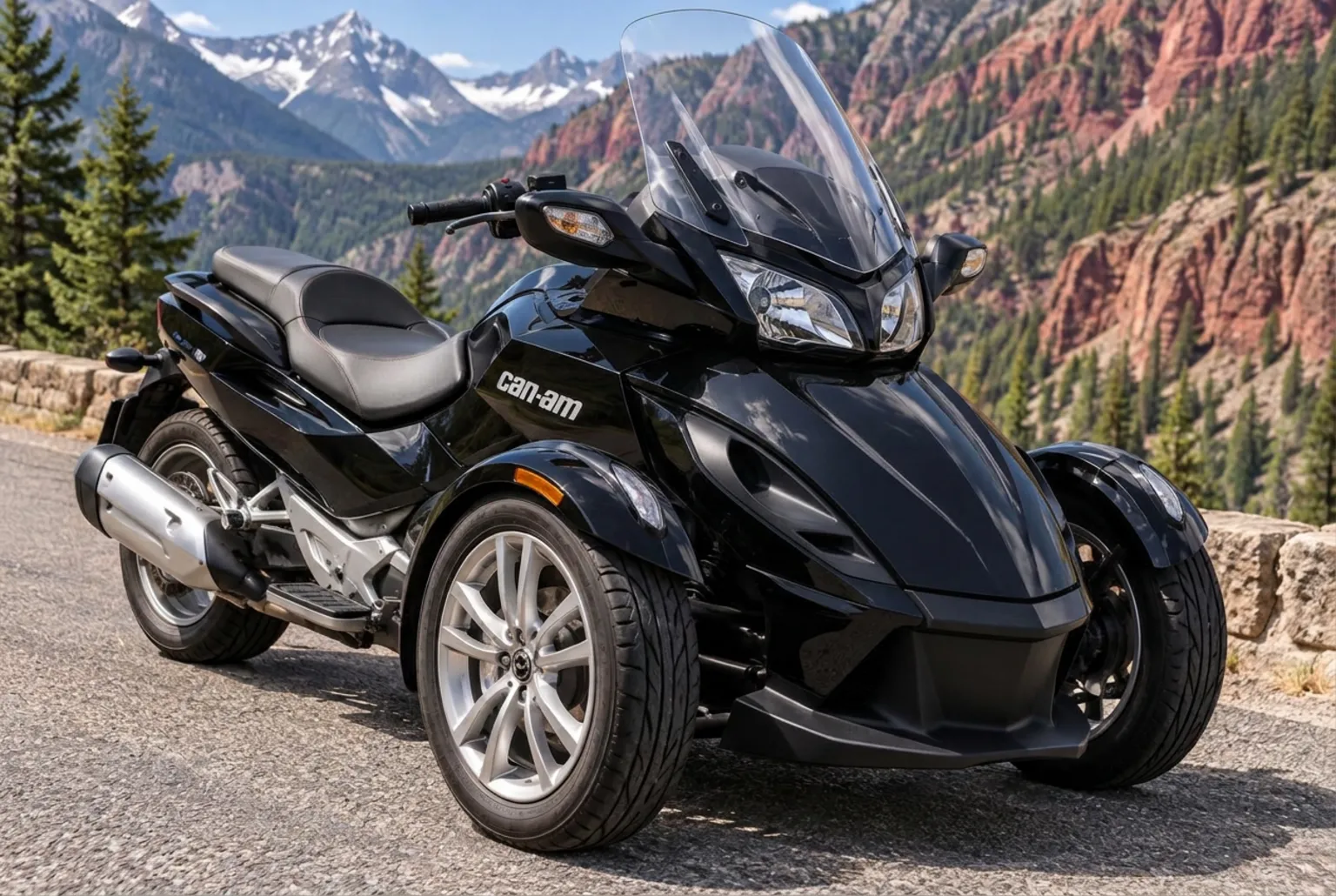
Spyder F3
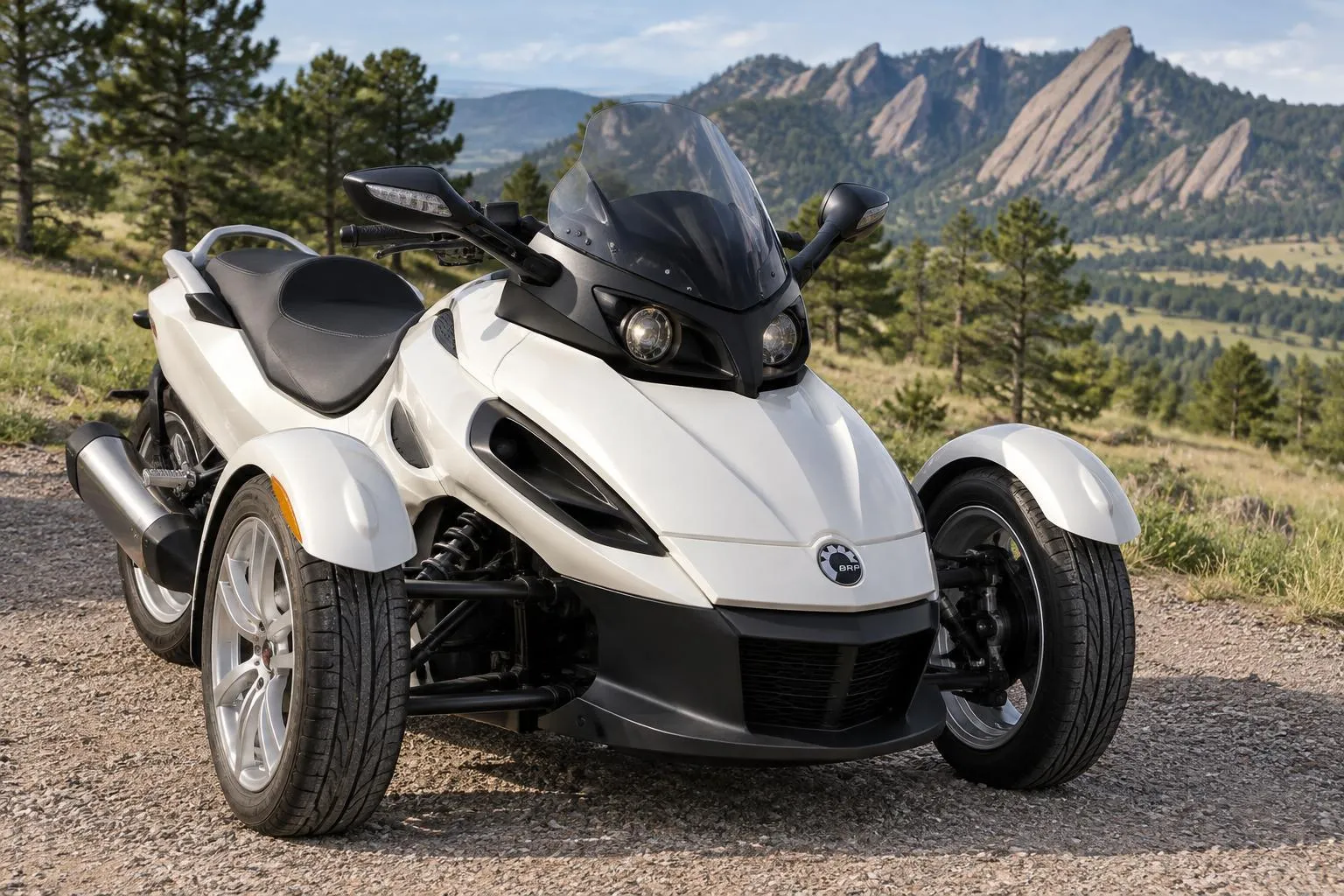
Open rear body and cruiser control position
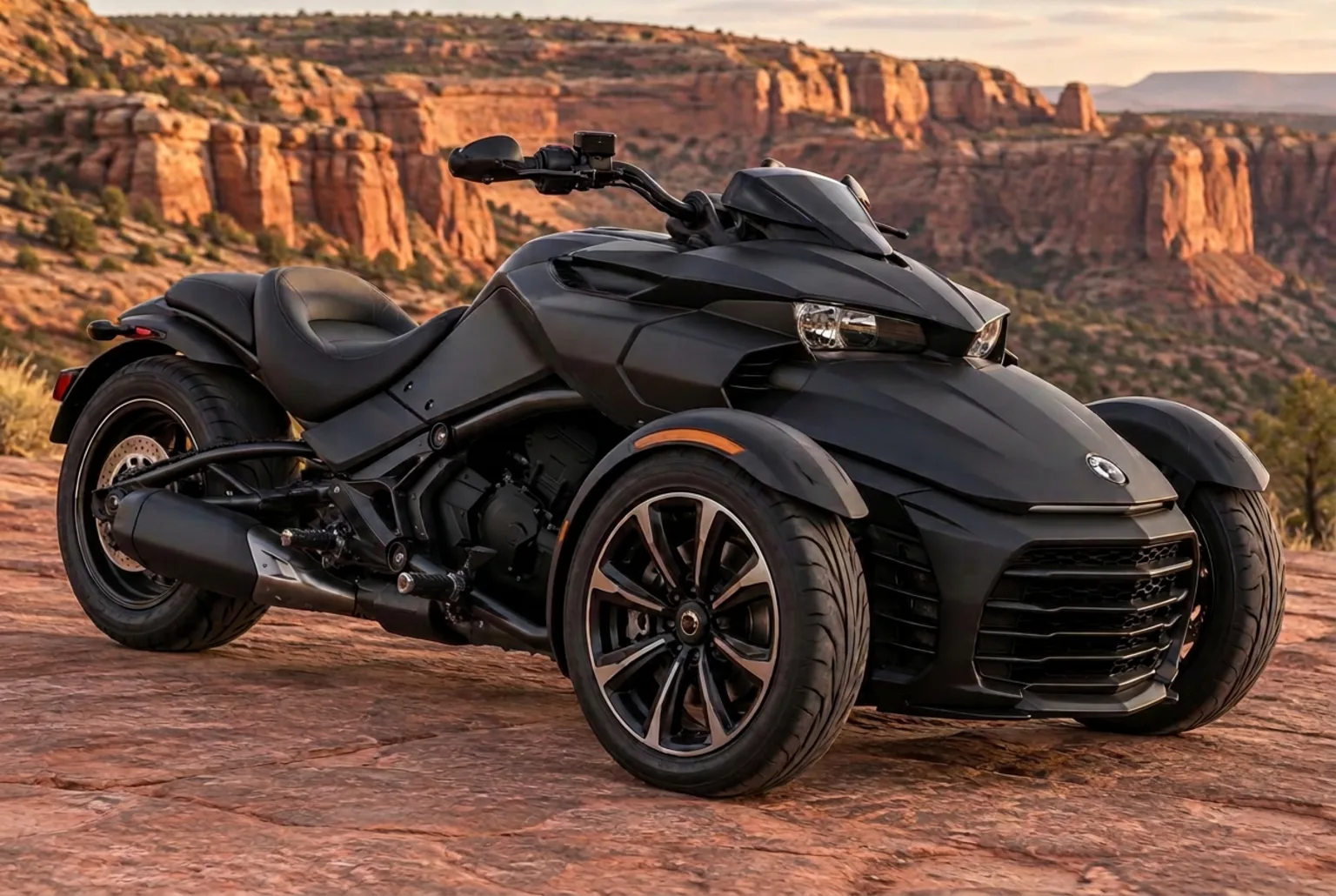
The Spyder F3 joined the Can-Am lineup for model year 2015 with the Rotax 1330 ACE inline-three. Its lower, cruiser-style riding position and UFit system gave the Spyder lineup a distinctly different riding configuration from the RT.
The F3 arrived in 2015 with its own unmistakable shape. More than a decade later, that basic identity remains—while the names, body configurations, equipment, and technology have developed around it.
The Can-Am Spyder F3 entered the lineup for the 2015 model year with a low saddle, forward-positioned foot controls, exposed structural details, and a front end that made no attempt to disguise its three-wheel layout. Power came from BRP's Rotax 1330 ACE inline-three. Its UFit system offered a way to alter handlebar and foot-control positions within the same motorcycle's basic architecture. The result was a distinct member of the Spyder family, not simply an RT with its luggage removed.
Over the years the F3 name has appeared on machines with a compact, open rear profile, motorcycles with integrated side cases, and touring configurations with removable rear luggage. The instrument displays, wheel treatments, seating, suspension equipment, and factory packages have also changed. Yet these developments belong to one F3 model family, not a series of separate platform generations.
This reference follows the F3 from its 2015 introduction through the 2026 model year. It covers the base F3, F3-S, F3-T, F3 Limited, and documented special editions as distinct configurations, and explains changes by the actual year they appeared.
Open rear body and cruiser control position
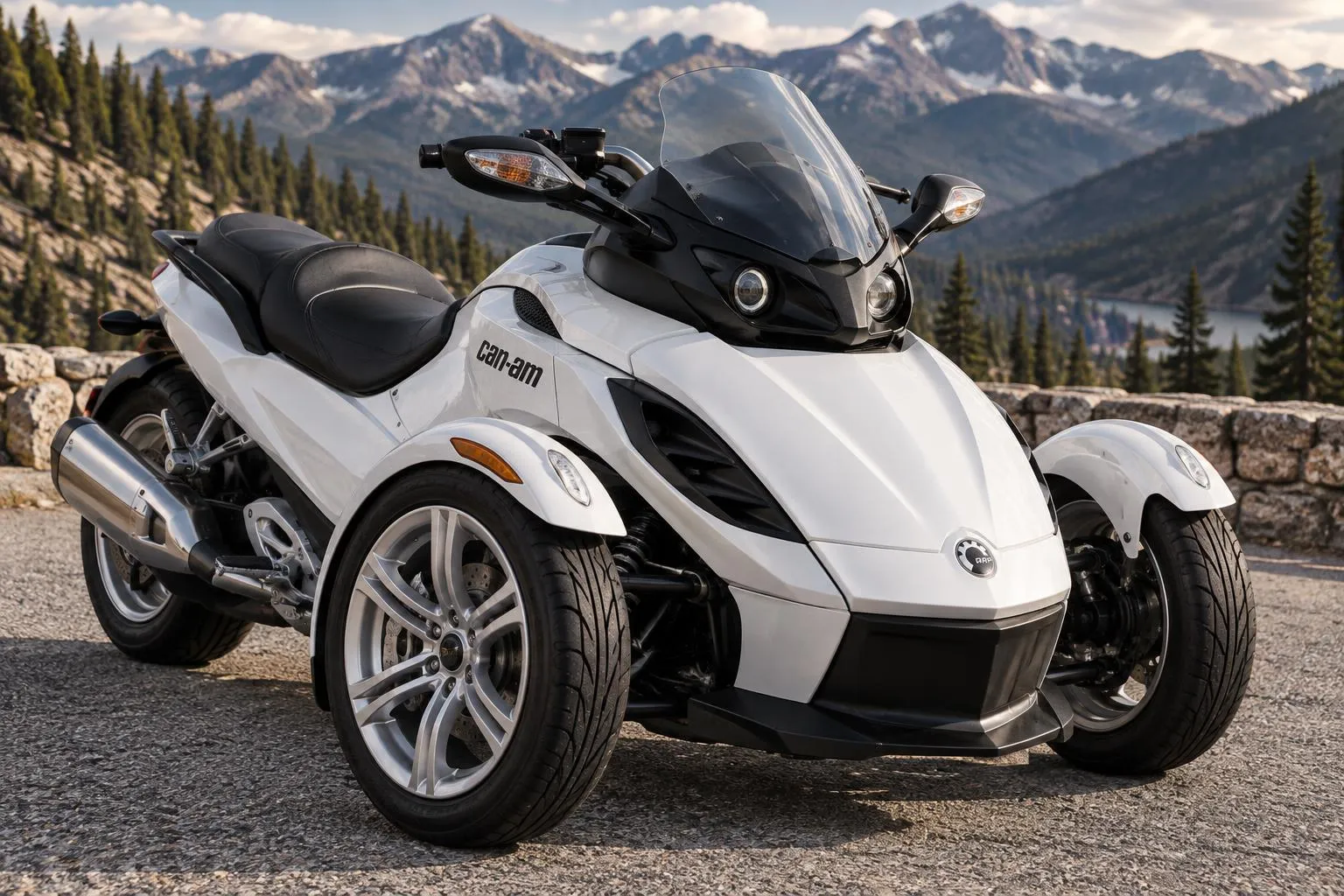
Added cruise control and upgraded finishes for 2015
Integrated side luggage and windshield, introduced for 2016
Side luggage and audio, before the removable top case
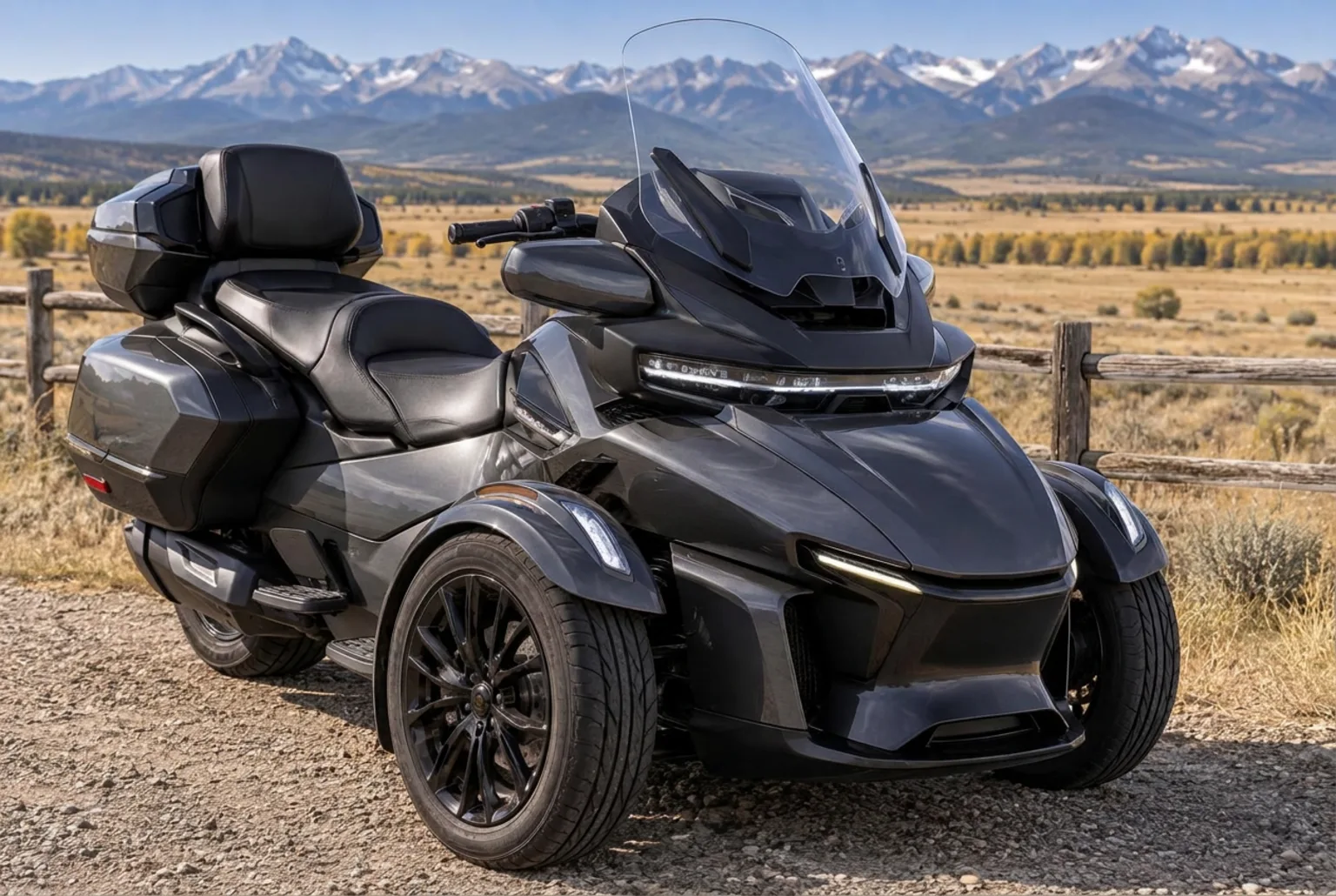
Removable rear top case with passenger backrest
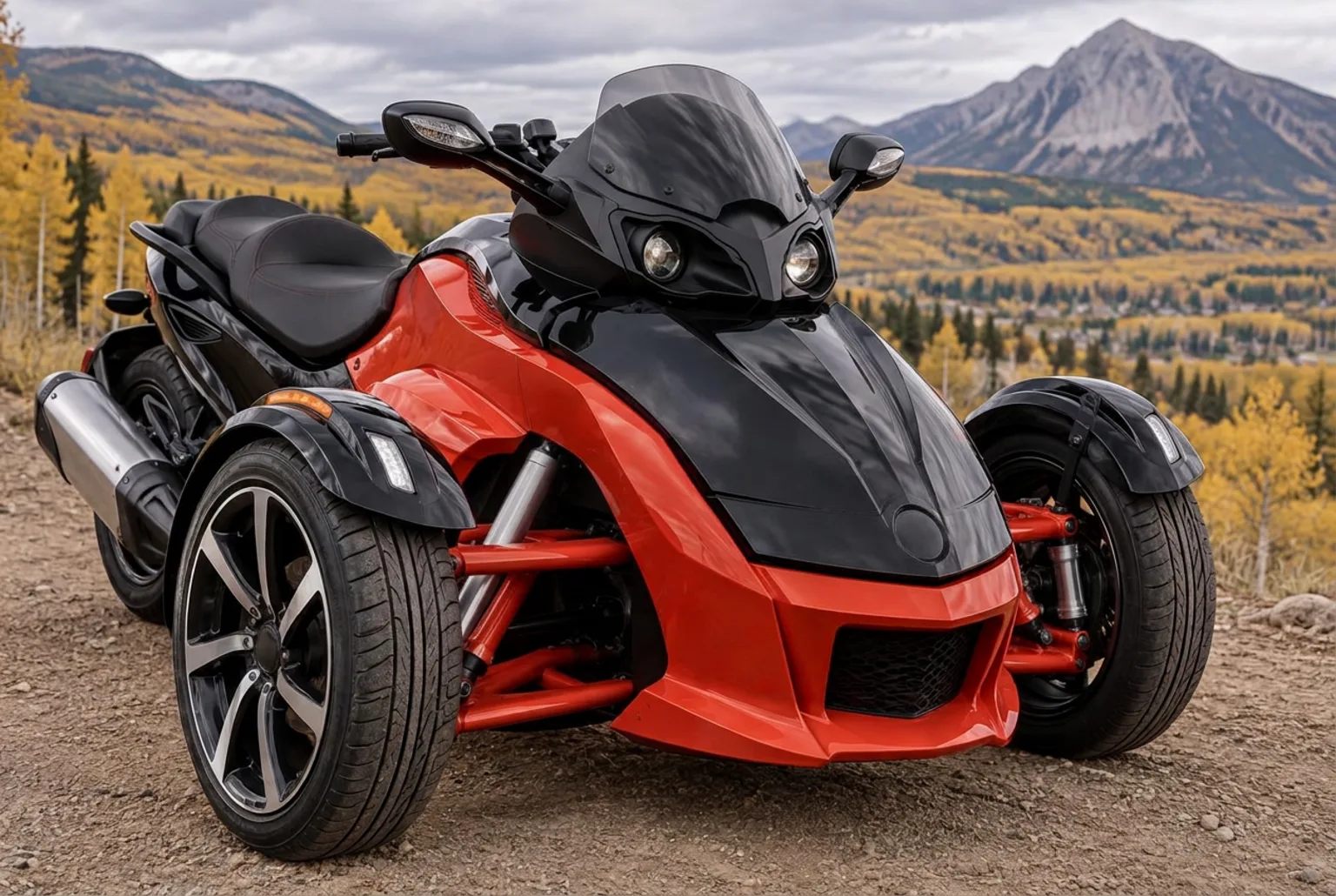
Factory packages within the family, not separate generations
The base F3 was there at the beginning, alongside the F3-S. Its 2015 factory configuration established the family's exposed rear profile, cruiser-style control arrangement, and distinctive body design. For 2015 the F3 was offered with either the SM6 manual or SE6 semi-automatic transmission, and electronic cruise control was one of the features the F3-S added over the base model.
The base F3 remains part of the family history in every year it was offered. A modern F3-S specification is not a substitute for an early base F3 factory sheet.
The F3-S debuted in the same 2015 model year. For 2015 it added electronic cruise control, upgraded wheels with machined gloss-black accents, a black suede seat with red stitching, premium front fenders with LED running lights and additional colors. Later F3-S models brought other features and named editions.
For 2017 the F3-S gained Sport Mode, which turns off the Traction Control System while the Stability Control System stays engaged; it does not disable every electronic assistance system. Named packages such as Triple Black and the Daytona 500 Edition each have their own equipment and model-year context.
BRP introduced the F3-T for 2016, adding integrated hard side luggage, a windshield, a touring-oriented upper-console arrangement and its own equipment options while retaining the F3 identity. On the 2016 F3-T, the audio system was optional. Transmission availability varies by year; the 2018 factory F3-T specification lists the SE6 semi-automatic.
The F3-T has its own rear-air-suspension arrangement: the 2018 F3-T specification lists a rear shock with manual air preload adjustment, a relevant service and identification detail.
The F3 Limited also joined the lineup for 2016. Its 2016 equipment included factory audio, heated rider grips, rider footboards and a Limited signature seat, along with the F3-T's side luggage. The removable factory top case did not arrive on the Limited until 2017.
The 2017 F3 Limited brought a prominent change in its touring silhouette: BRP described a new removable rear top case with passenger backrest, able to hold two full-face helmets, alongside automatic self-inflating air suspension, heated grips, footboards and a six-speaker audio system. That case gave the Limited a visibly different rear profile.
Factory specifications list a self-leveling rear air preload on the F3 Limited (for example, the 2023 sheet), unlike the F3-T's manual adjustment. Subsequent Limited model years received their own changes in displays, finishes, Special Series packages and other equipment. A later Limited may also be ridden or pictured with its removable case off, so an absent case is not, by itself, proof that the machine is a 2016 Limited.
These are factory packages and editions within the F3 family, not separate generations. Documented examples include the 2016 Triple Black Special Series F3-S and F3 Limited, the 2017 F3-S Daytona 500 Edition, and later F3 Limited Special Series models.
The details go beyond color. The 2016 Triple Black models had black-chrome six-spoke front wheels and a signature seat; the Daytona 500 Edition added a gauge spoiler, super sport grille, mono seat cowl, drag-style handlebar and Deep Black High Gloss front wheels. More recent F3 Limited Special Series factory sheets document different equipment for 2023, 2024 and 2025; the 2025 sheet specifically lists a backup camera.
| Model year | Documented milestone |
|---|---|
| 2015 | F3 and F3-S launch with the 1330 ACE, UFit and a choice of SM6 or SE6. |
| 2016 | F3-T and F3 Limited join the family; Triple Black Special Series F3-S and F3 Limited. |
| 2017 | Removable top case on the F3 Limited; Sport Mode and the Daytona 500 Edition on the F3-S. |
| 2018 | F3-T specification lists a 7.8-inch panoramic LCD with BRP Connect, SE6 transmission and manual rear air preload. |
| 2023 | F3 Limited and F3 Limited Special Series specifications still list the 7.8-inch panoramic LCD display. |
| 2024 | 10.25-inch touchscreen on 2024 F3 models (BRP campaign 2024-4 covers all 2024 Spyder F3); F3-S and F3 Limited sheets list it with Apple CarPlay. |
| 2025 | Special Series factory sheet documents an available backup-camera configuration; it does not apply across all Limited trims. |
| 2026 | F3-S, F3-T and F3 Limited appear in the U.S. model lineup. |
This timeline lists documented milestones only. Years not listed also brought color, package and equipment changes.
The F3 story combines continuity and variation. The engine-family name stayed familiar, while the actual transmission, suspension and instrumentation depend on the trim and year.
| System | Factory reference point | Important limit |
|---|---|---|
| Engine | Rotax 1330 ACE, liquid-cooled inline three-cylinder, 1,330 cc | Manufacturer specification; use the exact model-year guide for procedures. |
| Transmission | SM6 manual and SE6 semi-automatic six-speed systems appear in the F3 history | Availability depends on year, trim and package; the 2018 F3-T lists SE6 |
| Engine rated output | 115 hp (85.8 kW) at 7,250 rpm (2018 F3-T specification) | Factory rating for the stated model and year, not a dyno test. |
| Engine rated torque | 96 lb-ft (130.1 N·m) at 5,000 rpm (2018 F3-T specification) | Same year limitation. |
| Rear suspension | Manual rear air preload on F3-T (2018) and self-leveling air preload on F3 Limited (2023) | Confirm the fitted system and exact year. |
| Instrumentation | 7.8-inch panoramic LCD (2018 F3-T, 2023 F3 Limited) and 10.25-inch touchscreen (2024 F3-S and F3 Limited) | Trim, hardware and software version matter. |
| Luggage | Open rear configuration (F3/F3-S), integrated side cases (F3-T/Limited), removable Limited rear top case introduced in 2017 | Accessories and case removal can change appearance; one component alone does not identify the original trim. |
A display is often a useful clue to an F3's equipment era, but display size alone is not a definitive year or trim identifier. Factory specifications list a 7.8-inch panoramic LCD on the 2018 F3-T and the 2023 F3 Limited, and a 10.25-inch touchscreen with Apple CarPlay on the 2024 F3-S and F3 Limited.
The newer touchscreen brought additional connectivity capabilities, including the Apple CarPlay rollout and subsequent software work. BRP's 2024 communication 2024-4 addresses touchscreen software, CarPlay and other improvements. A later NHTSA campaign, 26V575000, concerns an eligible touchscreen instrument-cluster safety population. Those are different records. A software-update invoice does not, by itself, establish that any separate safety campaign applicable to a particular VIN was completed.
The F3's familiar powertrain does not mean a single service chart applies to every machine. The 2015 BRP guide, for example, gives a first inspection at 5,000 km (3,000 miles) and subsequent engine oil/filter timing at 15,000 km (9,300 miles) or one year. It also differentiates the SM6 clutch-fluid service from the SE6 hydraulic-control-module filter. Factory fill quantities and the correct oil-level-checking sequence have their own transmission-specific instructions.
The maintenance schedule is not identical in every year's guide, so check the guide for your model year. A low-mileage machine can still have time-based work due. Before maintenance, identify the year and transmission and consult the correct factory guide. The manufacturer's procedures—not a model-family summary—control exact oil-check temperature, tools, torque, service quantities and specifications.
A model-year range can give a reason to look into a campaign, but it cannot tell you whether a particular motorcycle is included or whether its repair was completed.
Two separate driveline recall records are especially easy to confuse: 22V352000 covers certain 2015–2019 F3 and RT motorcycles whose front sprocket may wear prematurely, while 24V728000 concerns certain 2017–2019 F3 and RT motorcycles whose engine output shaft may fatigue and break. Both campaigns cover certain motorcycles in those years, not every one. A sprocket-related service invoice is not proof that separate shaft-related obligations were addressed.
Other known campaigns include a mirror-lens recall for certain 2022 F3 and F3-S motorcycles, a recall of Coast to Coast accessory passenger seats built November 2015 to April 2016 for F3-series motorcycles, and a touchscreen instrument-cluster recall covering certain 2024–2026 F3 models. Manufacturer service communications, such as the 2024-4 software update, are separate from safety recalls. A service communication is not automatically a recall or proof of a widespread fault.
For individual eligibility, current remedy information and completion status, use the motorcycle's VIN and BRP/dealer campaign records.
Some F3 details are easy to change. A top case can be removed, a windshield replaced, a seat swapped and aftermarket wheels installed. A model badge can be obscured by paint or accessories. For that reason, use the VIN, the year-specific factory guide and the documented original trim when identifying service requirements or selecting factory parts.
The F3 Limited shows why: the removable rear top case arrived for 2017, yet it can be taken off, so its absence alone does not identify the year.
The F3 has been one recognizable model family for over a decade. Understanding it means seeing what stayed consistent while paying attention to what actually changed: trims, original equipment, luggage, transmission availability, displays and service requirements.
About this reference: it summarizes documented F3 history and selected technical information and is not a substitute for exact-year factory service instructions. Equipment, specifications and campaign applicability depend on model year, trim, transmission, market and VIN.
Mighty Ride Moto is an independent Can-Am Spyder specialist. For F3 maintenance, diagnostics and repairs, bring us the model year, known trim, recent service history and a description of the concern. That information gives the conversation a useful starting point, whether the motorcycle is an early open-body F3 or a later luggage-equipped touring configuration.